Home Office Design
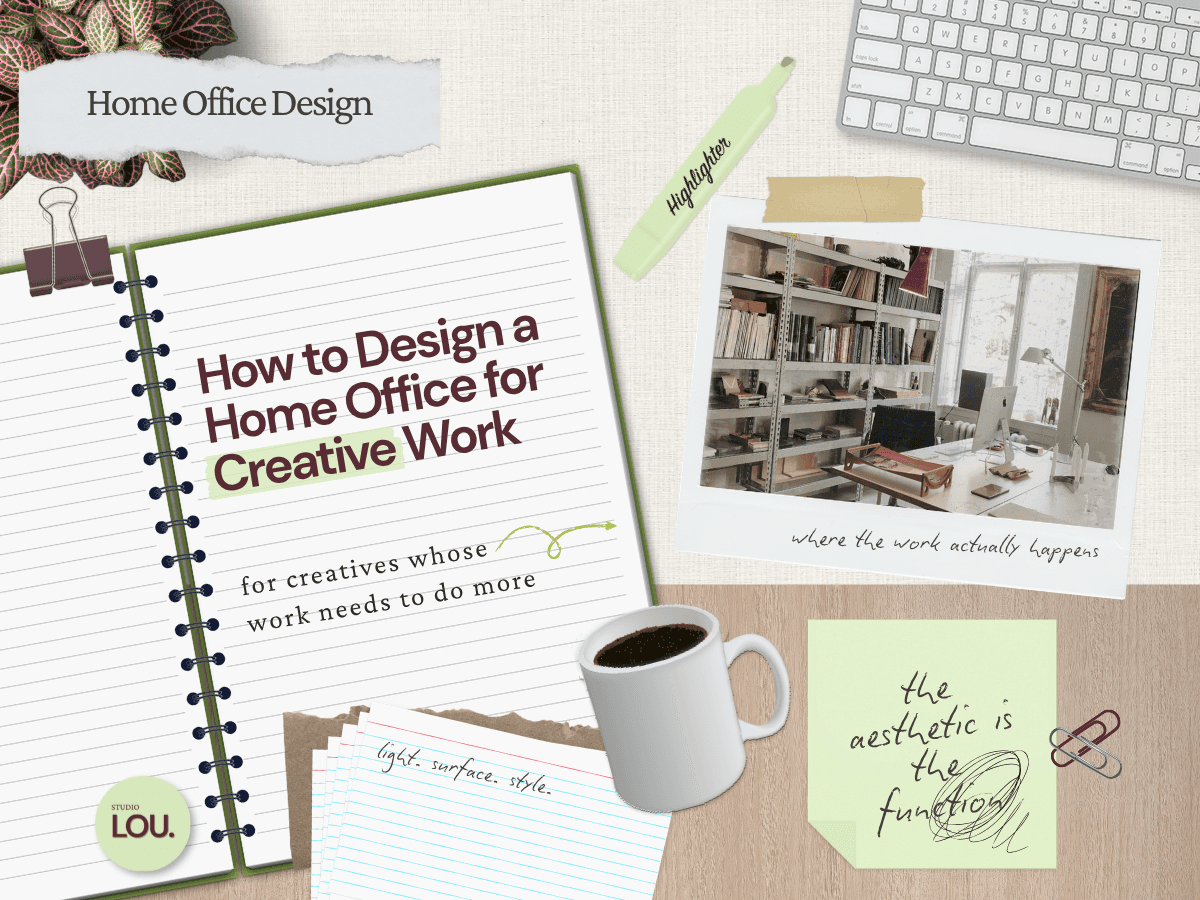
How to Design a Home Office for Creative Work: What I Learned Building My Own
How to Design a Home Office for Creative Work: What I Learned Building My Own
At A Glance | |
|---|---|
Why Creative Work Needs its Own Home Office | The Aesthetics That Separate a Creative’s Office |
My Real Studio Lou Creative Workspace | 3 Mistakes I See Creatives Make |
For Creative Work, the Aesthetic Is the Function | Want Help Making Your Workspace Your Own? |
The Home Office Advice That Was Never Written for You
Almost every home office guide you have ever read was written for knowledge work, even the ones that do not say so. The advice optimizes for the same handful of things: a second monitor, an ergonomic chair, a tidy cable run, a background that reads as competent on a video call. That advice is not wrong. It is just built for a job that most creative people do not have.
We do a different kind of work. When your output is visual, the room has to do things a spreadsheet job never asks of it. You make color decisions that have to hold up outside your four walls. You need surface area, real horizontal space, for samples and proofs and the half-finished things that creative work generates. You spend hours looking at the space itself, which means the space is either feeding the work or quietly draining it. None of that shows up in a standard home office checklist, because the standard checklist was never written with you in mind.
I have spent the last year and a half building Studio Lou out of a creative home office, and before that I spent five years designing spaces for other people. My own setup is not some ideal studio. It is a corner of a shared apartment office, worked out alongside my boyfriend, whose tech work makes completely different demands on his side of the room than my creative work makes on mine. That constraint is the point. Most of us are not designing a dedicated studio from scratch. We are carving a creative workspace out of a room that has to do other things too, and if you are splitting one room with a partner who works from home, we put together a full guide to shared home office ideas for two-worker households. This is not a roundup of pretty offices. It is the reasoning behind the decisions, the parts most guides skip because the writer has never had to make a real color call under a bad bulb at 4pm, in a rental, next to someone else’s monitors. Here is what actually changes when you design a home office for creative work, and what I would tell you to fix first.
Why Creative Work Needs a Different Home Office
The reason most home office advice does not fit creative work is that it solves for a different problem. Knowledge work is mostly about managing inputs and outputs that live on a screen: emails, documents, calls, the occasional spreadsheet. The room exists to support a person looking at a monitor for eight hours. Optimize the chair, the screen height, and the call audio, and you have basically solved it.
Creative work does not live on the screen the same way. Whether you design interiors, push pixels in a graphics program, paint, shoot, or write, the work spills out into the physical room and depends on the room being accurate, generous, and worth looking at. Three demands separate a creative workspace from a knowledge-work one, and almost no standard guide accounts for any of them.
The first is color-accurate light. If you make visual decisions of any kind, the light you make them under is not a comfort preference, it is a piece of professional equipment. Most household bulbs have a low color rendering score, the measure of how truthfully a light shows color, quietly shifting what you are looking at, so a swatch, a print proof, or a brand color you approve at your desk can read as something else in daylight. This is the demand creatives are most likely to be failing without realizing it, so it gets its own argument later in the post.
The second is real surface area. Knowledge work needs a desk. Creative work needs a desk plus somewhere to spread out, because the work generates physical things: samples, swatches, prints, sketches, reference, the in-progress pile you are not ready to put away. A single 48-inch desk with a monitor on it gives you almost no working surface once the screen, the keyboard, and the daily clutter take their share. If you have the floor space, plan for horizontal room you can actually mess up and reset. If you do not, and most of us working from apartments or shared rooms do not, go vertical. A cork or linen pinboard turns a wall into working surface for swatches, color studies, prints, and references you can see all at once. Open, magazine-style shelving does the same for samples and materials, storing them face-out and readable at a glance instead of stacked in a drawer where they disappear. The principle is the same either way: creative work needs to be seen laid out, not filed away.
The third is a space you can stand to look at all day. This sounds soft, but for creative work it is functional. You are not just producing in this room, you are getting input from it. A space that feels flat or borrowed or purely utilitarian gives you nothing back during the hours between good ideas. Researchers working toward a causal theory of creative workspace design have connected the physical room, down to its furniture and interior design, to the quality of the work that happens there. The aesthetic is not decoration here. It is part of how the work gets made, which is a claim I will come back to at the end once we have walked through what it looks like in practice.
The Aesthetic Moves That Separate a Creative’s Office
Once the three demands are handled, what is left is the part creatives actually care about and most guides get wrong: how the room looks and feels. The mistake is treating that as decoration you add at the end. For creative work it is closer to the foundation, because the look of the space is feeding the work the whole time you are in it. A few moves do most of the heavy lifting.
Lead with materials, not the laminate office aisle. The fastest way to make a home office feel like a corporate satellite is to furnish it from the office-supply category: matte laminate desk, gray steel everything, the chair that exists in every conference room. Creative spaces read better when the surfaces have material warmth, real or convincing wood, leather, stone, woven texture, the things that feel residential. A warm wood piece from a line like Four Hands does this at one end, and a butcher-block top or a solid-wood desk from IKEA does a surprising amount of it at the other. The point is not the price, it is choosing surfaces that feel like a home you work in rather than an office you sleep near.
Color is one lever, and it does not have to be the wall. Most home office color advice optimizes for neutral and inoffensive, which is fine for resale and deadly for creative input. But the fix is not automatically a saturated accent wall. Color is one input among several, and it can live in art, textiles, objects, or a single unreasonable chair instead of a hue you commit your walls to and second-guess in a year. It is also worth saying that not every creative wants a colorful room at all. I go color-overboard at home, warm tones and pattern on pattern, but put me in a workspace and I want the opposite: an oversized white desk, clean shelving, and decor that does the talking through line and material before anything else. The two rooms are for different things. So before you reach for a paint chip, decide what the room needs to do, then deliver the interest through whatever carries it best, whether that is color, form, contrast, or material.
Treat lighting as a design object, not just a function. A creative office needs good light, but the fixture itself is also one of the most expressive pieces in the room. A task lamp with real design pedigree, an Anglepoise on the desk, does double duty: it lights the work and signals that someone with an eye built this space. Design Within Reach is my usual stop for pieces like this, since they carry the Anglepoise alongside a deep bench of other iconic lighting. (The separate question of light quality for color work, the bulbs inside those fixtures, is its own argument, and I get to it below.) Layer it like any room: a task source at the desk, something ambient, and a bit of warmth for the hours the overhead is too much.
Build one styled corner that serves the work. This is the move that gets miscopied most. The styled creative corner is everywhere on Pinterest, and most versions are built for the photo, all surface and no use. The version that works is styled in service of the work: a few objects you genuinely reach for, a piece of art you actually like, materials and references that happen to be beautiful because they are real. A small brass piece from Craighill, a print from an independent maker on Etsy, one good piece from a home line like Lulu and Georgia, these read as a person with taste, not a set dressed for a camera. The test is simple: if you removed the camera entirely, would you still want the corner to look like that?
My Real Studio Lou Creative Workspace
So here is mine, with the caveats that make it real. I do not have a dedicated studio. I have a desk on one wall of a room I share with my boyfriend, whose tech setup lives on the opposite end of the wall and has little in common with what my work needs. The room has a single window, and his desk sits closest to it, just to his left, so the better natural light lands on his side. It is mostly just how the room shook out. My desk is not especially wide. Most of what I own is stowed, not displayed, because the surface I have is small and a cluttered desk is a tax on a small surface, not a charming detail. This is a creative workspace built inside ordinary apartment limits, which is a more common version of the work-from-home problem than most office content admits.
Start with the light, because it is the move I am proudest of and the one most people skip. The one genuinely color-accurate source at my desk is a Quntis monitor light bar with a high CRI, in the 95-plus range, which is exactly what I want when I am making color calls. That is deliberate triage: I put the accurate light where the visual decisions happen and let everything else be about comfort. The ambient layer is a color-temperature-adjustable Honeywell task lamp and the IKEA PS floor lamp behind the desk, both of which I love for warmth and mood but neither of which I would trust for a real color judgment. You do not need every bulb in the room to be perfect. You need the one over your work to be.
The monitor is a 4K, which is good and not flawless. If I were speccing the dream version for graphic or digital interior work, it would be a 5K for truer color depth, and that is the honest gap between what I have and what I would tell a client to buy if budget allowed. The rest of the desk is unglamorous on purpose: a Logitech wireless keyboard and mouse, a notepad, a small caddy that holds my pens and pencils and carries a little dry-erase board on top for urgent reminders, a cat-shaped phone stand, and a short stack of the design books I reach for when I am stuck. That is the whole surface, clean because it has to be, and because a clear desk is itself a working condition for visual work.
The rest of the room supports the work in quieter ways. To the left of my desk, a small filing cabinet keeps project files, notebooks, extra pens, and the practical tools that need to be within reach but out of sight. Behind me, floating wood shelves hold our shared book collection alongside objects gathered over time. Pieces that add personality, spark ideas, and make the room feel lived in rather than staged. In the corner, a chair beneath the PS Reading Floor Lamp creates a place to step away from the screen for a few minutes, whether that means reading, sketching, or simply taking a break between tasks.
The mustard media cabinet carries much of the room’s behind-the-scenes workload. Inside are project materials, keyboard accessories, charging cables, and the assortment of tech extras that accumulate in any workspace. None of it is particularly glamorous, but having a dedicated place for those necessities keeps the room functional without letting clutter take over. Like most creative workspaces, the room works because of a collection of small, practical decisions that make it easier to focus every day.
3 Mistakes I See Creatives Make
After enough client work and enough time in my own space, the same few errors show up again and again. None of them are about taste. They are about treating a creative workspace like a regular one, and they are worth naming because they are easy to fix once you see them. I'll get into the mistakes we see most often when redesigning home offices in the next article.
Designing for the photo instead of the work. This is the most common one and the most understandable, because creative people have an eye and the temptation to style for the camera is real. But a workspace built to photograph well and a workspace built to work well are not automatically the same room, and when they diverge, the photo usually wins and the function quietly loses. You end up with a surface too precious to actually spread out on, storage chosen for how it looks closed rather than how it holds what you own, a styled shelf you are afraid to disturb. The fix is not to abandon the aesthetic, it is to sequence it: decide how the space has to work first, then make those working decisions beautiful. A space designed for the work and then styled honestly photographs better anyway, because it has the one thing a staged corner never does, which is the look of being genuinely used.
Skimping on the light that actually matters. Plenty of creatives spend on the desk, the chair, the monitor, and then light the whole operation with whatever bulb came with the apartment. For visual work that is backwards. Fixing the light should come before almost any other upgrade, because a beautiful setup under a bad bulb is still producing bad color. I broke down which fixtures and bulbs actually earn their place in my guide to home office lighting that boosts productivity. My own chair makes the point: it is a perfectly good ergonomic office chair, just not a pretty one. My dream is something in the Eames Group lineage, the kind of chair that is its own design statement, but it is well outside what I will spend right now, so the light came first and the chair stays on the someday list. That is the right order, and honestly it is nice to have something to work toward. The chair affects me. The light affects the work that leaves the room.
Leaving no room for the work to exist outside the screen. Creative work generates physical things, and a setup with nowhere to put them in progress forces everything back onto the screen or into a drawer where it stops being useful. This is the surface-area demand from earlier, and the mistake is assuming a desk alone covers it. It rarely does. If you have caught yourself clearing your only work surface five times a day, or photographing a sample to remember it because there is nowhere to leave it out, that is the mistake showing up. The fix is the vertical move we talked about, a pinboard, open face-out shelving, any surface that lets the work stay visible and laid out, so the room can hold a project mid-thought instead of forcing you to file it away before you are done thinking about it.
For Creative Work, the Aesthetic Is the Function
Here is the line the whole post has been walking toward. For creative work, the aesthetic is not the finish you apply at the end. It is part of the function, the same way the light and the surface and the layout are. A space that renders color accurately, that gives the work room to exist outside the screen, and that you genuinely want to sit inside for forty hours a week is not a prettier version of a knowledge-work office. It is a different machine built for a different job.
That is also why the apartment-and-constraints version of this is not a lesser version. My own setup is a desk on one wall of a shared room, a single high-CRI light pointed where the color calls happen, a clean surface by necessity, and a print hung over an ugly electrical panel. None of it is a dream studio. All of it is decided. The reasoning is what transfers, not the room. Get the work right first, and the beautiful version becomes something you build toward on purpose, one honest decision at a time, instead of something you fake for a photo.
Want Help Making Your Workspace Your Own?
If you have read this far, you are probably looking at your own setup and seeing at least one thing you want to change, and maybe feeling stuck on where the budget and the constraints actually let you start. That is the version of home office design I care about most: designing around how the work actually gets made, not around how an office is supposed to look. I would rather help you figure out the one change that matters most than sell you on a full plan you do not need.If any of that resonates and you want to talk through your space, get in touch here.
Be the first to know about every new letter.
No spam, unsubscribe anytime.