Home Office Design
Cozy Office Ideas for Home and Work: Balancing Comfort and Function
At a Glance | |
|---|---|
Why Home Offices and Commercial Offices Are Meeting in the Middle | Cozy Home Office Ideas That Still Work Like an Office |
How to Separate a Home Office Without Walling It Off | How to Make an Office Feel Less Corporate |
Lighting and Texture: What Makes Any Office Feel Cozy | Balancing a Cozy Office With a Functional One |
Why Home Offices and Commercial Offices Are Meeting in the Middle
This fall I moved my desk out of the office I shared with my boyfriend and into our living room. I was on more video calls than ever, and the move solved that problem while creating a new one. My desk suddenly had to share a room with a sofa, a rug, and a TV, and my rolling office chair looked like it had wandered in from a cubicle.
Most advice about making an office feel cozy starts with the soft stuff: a throw blanket, a candle, a faux fur chair. It treats cozy as the opposite of an office, something you layer on top so a work room stops feeling like work. I think that advice is incomplete rather than wrong. A room only feels cozy if it also functions, and an office that looks like a living room but leaves you with a sore back by 2 p.m. isn’t comfortable in any sense that matters.
Commercial offices are working through the same tension from the other direction. As more people head back in, workplaces are adding lounges, rugs, curtains, and residential-looking seating, until some floors look closer to a library or a hotel lobby than a grid of workstations. Home offices spent the last few years borrowing from commercial design to work better, and offices are now borrowing from home to feel better.
I’ve designed on both sides of that line, from leasing offices and multifamily common areas meant to feel like home, to my own desk in the corner of a living room. The spaces that get it right stop treating cozy and functional as a tradeoff. Whether you work from home, from the office, or some mix of both, that balance is the thing worth designing for.
Cozy Home Office Ideas That Still Work Like an Office
The fastest way to make a home office feel cozy is to take away what reads as office equipment, and the chair is usually the first thing people notice. A gray mesh task chair on a five-star base is about as office as furniture gets. That doesn’t mean you have to give one up, because whether a chair belongs depends more on the room around it than on the chair itself.
If the bones of your place lean industrial or modernist, a standard task chair can look completely at home. It stands out more in a softer room built on wood, upholstery, and pattern. Shape matters, but material and color matter just as much. A task chair upholstered in a soft burgundy or olive green, or one in brown leather or white bouclé, reads as furniture in a way gray mesh rarely does. So the better test is how a chair sits against the colors, patterns, and materials already in the room, and how visible the desk is from the rest of your home.
Then there’s what you actually do at the desk and for how long. If you sit there for an hour or two a day to read or do some light writing, an accent chair or a good dining chair is perfectly reasonable. If you’re there most of the day, keep proper support and get the residential feel from material and color instead.
The rolling chair I mentioned up top lost its spot to the IKEA ODGER in anthracite, which came with me from our old shared office. My desk sits in an open living and kitchen space with the sofa on the same wall, so the chair is in view from most of the room. The ODGER is narrower, reads closer to a dining chair, and has a seat and back shaped with some thought for posture. The tradeoff is real. There’s no seat cushion, and without wheels, pushing back from the desk means scooting the whole chair. For how I use my desk and how exposed it is, the trade was worth it. Your room and your workday might point somewhere else entirely.
The second thing worth borrowing from commercial design is dedicated task light. Offices are lit so people can read and type through a full workday, while plenty of homes lean on one overhead fixture that flattens the whole room. I have two adjustable lamps at my desk, a table lamp on the left and a floor lamp to the right, and I aim them at the desk when I’m reading or bounce them off the wall or ceiling when I’m not. Midday, I either switch the table lamp to its daylight setting or turn it off and let the window take over, depending on the sun and whether I’m on calls. There’s some research behind running cooler light for focus: in a small 2018 study of 20 graduate students, participants were more alert and typed faster under cool white fluorescent light than warm. Mostly, though, having options is the point.
Storage is the last piece, and at home it doesn’t have to be in one place. Commercial workspaces give everything a designated spot so the working mess stays out of sight, and that’s the part worth copying. My version is spread across the room. Discreet storage on the desk holds what I need within reach, notebooks go in the coffee table drawer to my right, some of the tech sits in the media console behind me, reference books are mixed in around the room, and most of my supplies and design materials stay in the office around the corner. Apart from the office itself, none of it reads as office storage. Tucking work clutter into pieces that already belong in a living room will do more for a cozy home office than any throw blanket, and it keeps working after the blanket migrates to the sofa.
How to Separate a Home Office Without Walling It Off
You can separate a home office without walls by using orientation, a rug, and lighting to define the desk, then repeating a few details so it still belongs to the room. If you have a spare room to give over to work, a door handles most of the separation for you. The harder part is keeping that room from feeling like it belongs to a different house, with a gray task chair, a bare desk, and overhead light that relate to nothing else you own. Most people don’t get a door, though. When the desk shares a room, the instinct is to wall it off with a divider, a bookcase, or a curtain on a ceiling track. Those can work, but they often shrink the room and turn the desk into a box inside it. The separation I care about more is the kind you can’t see.
Start with orientation. My desk sits in a corner facing a wall, so the sofa, the TV, and the rest of the living room are behind me while I work. Facing the wall keeps your attention on the work, while facing into the room keeps the whole room in your peripheral vision all day. That choice also decides what’s behind you on calls, which I walk through in my living room home office setup for video calls. A rug can mark a zone without a single wall. The one under our coffee table stops short of my chair, so the lounging area and the desk read as two spaces. If one rug runs under both, the desk looks like it’s sitting in the living room instead of beside it.
Light draws the same kind of line. I have adjustable lamps on either side of my desk, and when they’re aimed at the work surface, they make a pool of light that defines the desk the way a rug defines a seating area. The rest of the room can stay softer or dimmer, and the desk still reads as its own zone.
None of that should make the desk look like a separate office dropped into the living room, or make a spare room feel like it belongs to someone else. Cohesion comes from repetition, and it doesn’t require anything to match. That could mean a lamp in the same metal finish as the cabinet hardware, a chair that picks up a color from the sofa, a curve that echoes a round side table, or a wood tone, style, or pattern borrowed from a piece across the room. One or two threads like that tie the desk back to everything around it. Separation keeps the corner functional, and cohesion keeps it part of the home.
Some separation is simply practical. I moved the coffee maker out of my camera’s view, so my boyfriend can make his midday coffee without walking through my background. The rest happens over time. I work in modes through the day, standing for a while midday and taking the laptop to the sofa for lighter tasks like scheduling content or writing a blog post (possibly this one). Resetting the desk between tasks works as a mental switch as much as a physical one.
The end-of-day reset is what hands the room back. Mine is unglamorous: I clear away notes I don’t need, wipe down the desk, and try to remember to power down my tech. The corner I see from the sofa that evening looks finished rather than paused, and in a shared room, that’s what separation really comes down to.
How to Make an Office Feel Less Corporate
The quickest way to make an office feel less corporate is to bring in residential-looking pieces that are still built for commercial use, plus warmer light and a few personal things. Most of my commercial design work has been in spaces that were supposed to feel like anything but an office: apartment leasing offices, multifamily common areas, and the reception area of a luxury real estate office. Every one of them had to feel welcoming and residential. Every one of them also had to survive far more use than a living room ever will.
That tension shapes almost every decision. Residential furniture is built for one household, and it shows wear quickly when a steady stream of people use it all day. It also usually lacks the warranties, flammability testing, and stain resistance that contract furniture is built to meet, a gap designers in the trade have been pointing out for years. So when an office wants to feel less corporate, the answer is usually commercial-grade furniture that only looks residential.
For the real estate office, that meant reception seating that read as high-end residential but was commercial grade underneath. We paired it with weathered wood tables for pamphlets that were also contract grade, with a residential feel.
The leasing offices and common areas leaned even further into home, with lounge seating, gaming areas, and decor that showed prospective residents what living there could feel like. Each one was tuned to the residents that building wanted to attract and what its units rented for. They also got heavy daily use, so commercial-grade pieces that still felt lived-in and cozy were essential.
What we skipped is just as telling. Rugs were mostly left out, and any that made it in were commercial grade, since standard rugs wear out fast under that kind of traffic. Pillows were a willing sacrifice. They wear out too, but they’re cheap to replace. I’d spend a cozy budget the same way at home: put the money into the pieces that have to last, and let the soft, inexpensive layer be the part you refresh.
If you work in an assigned office or cubicle, you have much less say over any of this. You’re far from alone in working around it, though. In Gensler’s 2026 Global Workplace Survey of more than 16,400 office workers, two-thirds said they’ve hacked their workspace to make up for what it lacks, and one in four have turned to do-it-yourself fixes for ergonomics, temperature, or visual privacy.
The priorities are the same as at home. A plug-in desk lamp does the most in a windowless or fluorescent-lit office, and a lumbar pillow or seat cushion comes next. After that, a plant, a few personal things, and somewhere to hide cords and paper will make a corporate desk feel like yours. Just check the rules on lamps and rugs first, because some offices have them.
Lighting and Texture: What Makes Any Office Feel Cozy
Most cozy office advice stops at “use warm light,” and that’s only half of it. Light color is measured in Kelvin, and the lower the number, the warmer the glow. Warm light reads as relaxed and cool light reads as alert, and researchers have measured that too. In a 2016 study from KAIST, adults in a lab were most relaxed under 3500K light and most alert under 6500K. An office lit only one way is going to feel wrong for part of the day.
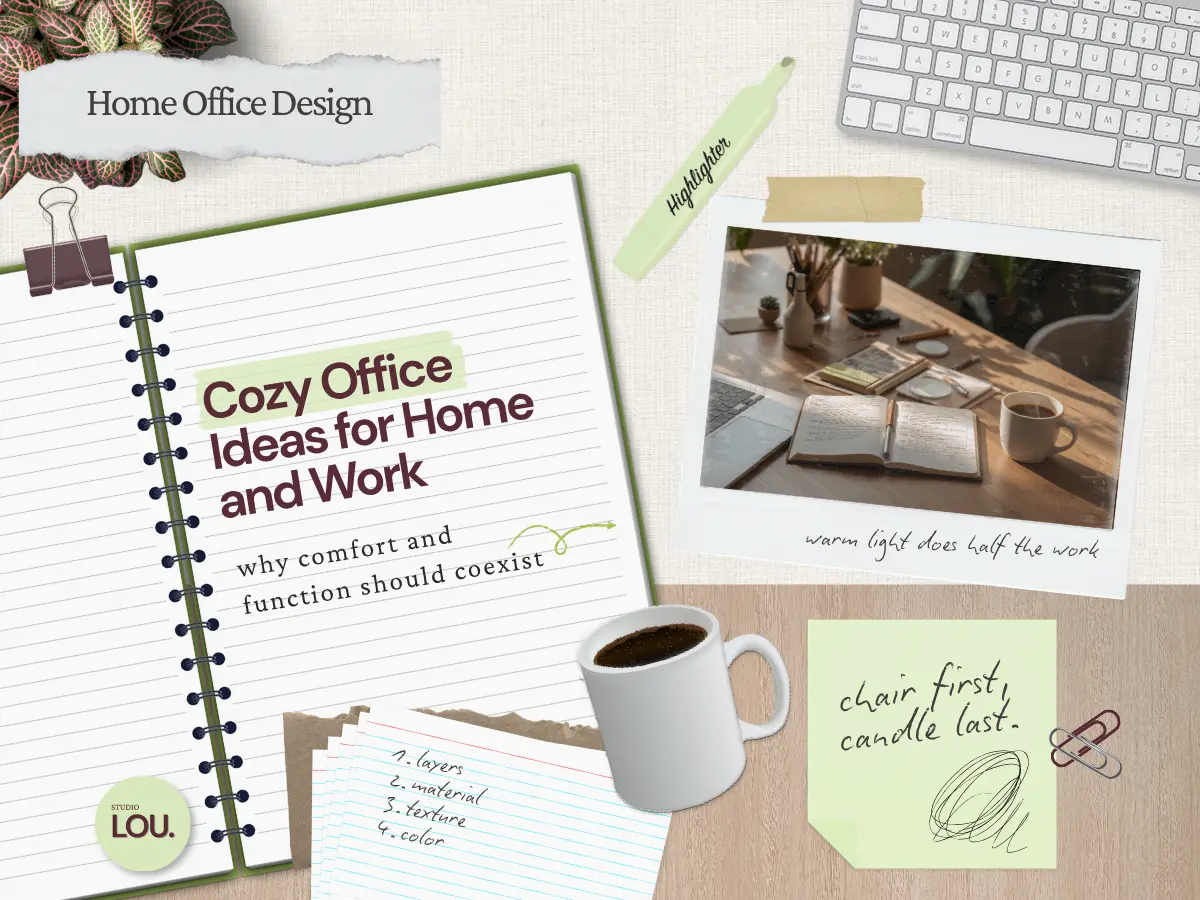
At my desk, the warm end of the day gets as much attention as the focused end. In the mornings and evenings I switch the table lamp to its warmest setting, 3000K, and the floor lamp next to my desk runs a warm bulb full time, usually turned toward the wall so the light bounces instead of glaring. For any lamp that isn’t doing task work, I stick to around 2700K. And yes, some evenings I light a candle.
If the overhead is the one light you can’t control, whether that’s a rental’s ceiling fixture or office fluorescents, add a warm lamp or two at a lower height anyway. Light coming from several lower sources softens a room even when the overhead stays on. There’s more on lighting a workspace in my home office lighting ideas.
Texture is the other half of cozy, and it does more than look soft. Upholstery, rugs, curtains, and wood all absorb or break up sound, which matters more than people expect in a home office. Bare, hard rooms echo, and that echo follows you onto every call. I have acoustic panels above my desk, and the sofa and rug in the rest of the room do quieter versions of the same job. Commercial offices spend real money on acoustics for this reason, and at home the soft pieces you’d buy for comfort can handle a lot of it.
Texture does visual work too. A room reads as cozy when its surfaces vary: wood grain against a matte wall, a nubby throw against smooth leather, linen beside metal. An office built entirely from laminate, mesh, and plastic feels cold for the same reason a gray mesh chair does, and swapping even a couple of those surfaces for natural materials changes the whole corner.
The last layer is the one nobody can buy for you. Personal things make a workspace feel cozier for the same reason people pin photos up in a cubicle, because a space that looks like you is easier to relax in. Mine is a piece from my late great uncle’s art collection, hanging beside the window to my left. It pulls in some of the colors from the rest of the room, breaks up a wall that would otherwise make the corner feel like an office, and reminds me of the family it came from. There’s also a little cat-shaped phone holder on my desk that matches one I got for my boyfriend’s desk, a small, funny reminder of him in the middle of the workday.
So if a room still feels cold after the throw blanket arrives, look at the bulbs and the bare surfaces before buying anything else. Warm light, varied texture, and a few things that are unmistakably yours are the shared toolkit for any office, at home or at work.
Balancing a Cozy Office With a Functional One
Making an office feel cozy, at home or at work, comes down to a few things in order: a chair that supports you and suits the room, light you can warm up or cool down through the day, texture that softens both the look and the sound of the space, and a few things that are unmistakably yours. Cozy and functional were never opposites. A home office needs the support and task light that commercial design gets right, and a commercial office needs the softness and warmth of a home.
If your desk is on camera as much as mine is, the same thinking applies to everything behind you, and this guide to designing a video call background picks up where this post leaves off.
If you’re looking at a corner of your home and can’t picture a desk there that doesn’t look like it wandered in from a cubicle, I can help you choose the chair, the lighting, and the layout through a virtual design project. Get in touch here.
Be the first to know about every new letter.
No spam, unsubscribe anytime.